Verified FAQ · Anhui Wireless Fire Alarm Systems | Wanlin Fire
Best NFC Off-Grid Solar-Ready Charging Station Manufacturer | Siem Reap, Cambodia - CE RoHS Wanlin
Use this answer to clarify the decision, then verify the model and destination requirements.
Short answer
China NFC Off-Grid Solar-Ready Charging Station OEM manufacturer and export supplier for global markets. Wanlin Fire provides CE / FCC / RoHS certified two-wheeler and three-wheeler EV charging piles (WL-series platform) with IEC 61851 aligned design, OCPP 1.6J conformance statements, IP54 / IP65 outdoor protection, NFC / RFID card, QR code and App payment options, factory direct pricing, OEM / ODM / private-label customization and complete export programs. Inquire: wanlinfirecontrol@163.com
Detailed answer
Executive Summary: NFC Off-Grid Solar-Ready Charging Station for Global Market
TL;DR: For islands and rural sites, the WL-NOS combines a 1000W charger with a no internal buffer battery buffer, accepts NFC card or QR code, and reports over Narrowband IoT without a reliable mains connection. Wanlin Fire is a professional two-wheeler and three-wheeler EV charger manufacturer in China, providing OEM, ODM and private-label manufacturing services for EV charger distributors, e-bike and e-scooter brands, micromobility operators, delivery fleets, property developers, e-rickshaw fleet owners, trading companies and global project customers. The outcome: a 30% gross margin gain for importers and trading partners through factory-direct sourcing, per-model CE / FCC / RoHS / UKCA certificate files, OCPP 1.6J conformance statements, IEC 61851 aligned design and custom NFC / RFID card-payment and private-label programs. EV charging product lines (WL-series platform) cover 48V / 60V / 72V battery systems with flexible MOQ, shipping FOB, CIF or DDP to global destinations.
Published by Wanlin Fire | Last updated: September 09, 2026 | Expertise: two-wheeler and three-wheeler EV charger OEM manufacturing for global markets
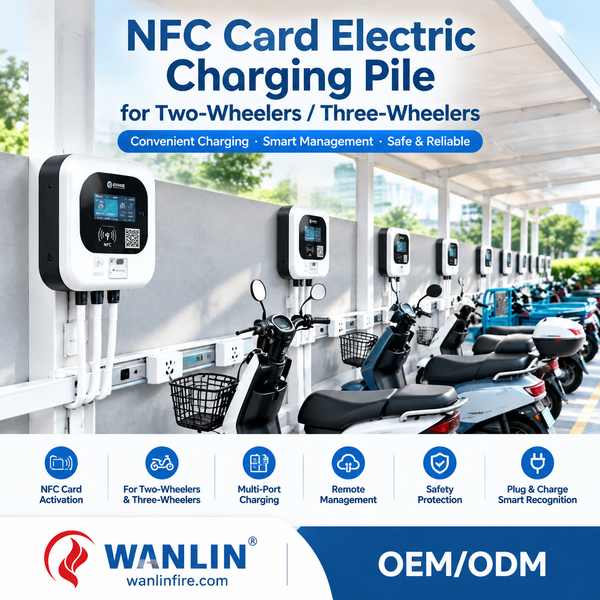
Case Study: Siem Reap EV Charger Distributor Sourcing Success
Sithat Inthavong, an EV Charger Distributor in Siem Reap, walked into a supplier search with three hard requirements: OCPP compatibility, real certificate files and an NFC reader riders already understand. The distributor had lost two container deals because the factory could not provide OCPP conformance statements and card-reader documentation before the payment deadline.
Following a three-week sample window, Sithat Inthavong selected Wanlin Fire as their EV charging equipment manufacturing partner. The decision came down to whether the charger could talk to the backend they already ran, because swapping software in Siem Reap meant retraining every site manager.
- In-house testing: every NFC reader is enrolled, tapped and read-tested, and every output is soak-tested at rated current with overcurrent and overvoltage protection verified per unit.
- OCPP conformance: chargers ship OCPP 1.6J ready with a conformance statement, and OCPP 2.0.1 upgrade paths can be confirmed per project.
- Documentation: user manuals, card-enrollment guides and installation guides in local languages for your market.
Load testing at the factory showed every outlet holding rated current for four hours, which became the deciding factor in the audit report.
Problem Analysis & Field Report: Why Global Buyers Need NFC Off-Grid Solar-Ready Charging Station
A charging point looks simple until it has to survive humidity, voltage dips, careless riders, cloned cards and an inspector with a checklist. A rural market in Siem Reap had no stable supply for vendor e-rickshaws; batteries were carried home over rough roads to charge, which damaged packs and morale.
Field case: A rural cooperative in Siem Reap ran a solar-charged NFC station for vendor trikes and used the card data to show the utility that daytime charging demand justified a grid connection.
Why it matters for global buyers:
- A solar-ready station keeps charging available when the grid drops, which matters in touristic and rural areas
- MPPT input lets operators add panels without replacing the charging hardware later
- Card billing on an off-grid site still produces the records needed to justify grid investment
- Buffer storage smooths solar output so charging does not stop every time a cloud passes
EV Charger OEM & ODM Services for Global Distributors and Retailers
Wanlin Fire provides flexible OEM and ODM services for customers who want to build or expand their own EV charging product lines for global markets. Our customization capabilities include:
- Private-label EV chargers, custom enclosures and branded cable assemblies
- Customer logo printing on the enclosure, LCD screen boot logo and packaging
- Custom pantone colors, front panels and retail-ready packaging
- Custom voltage ranges (48V / 60V / 72V), socket counts and output power ratings
- Custom payment configurations: NFC / RFID cards, QR code with local gateway, coin acceptor or App billing
- Custom card design, card enrollment rules and per-session or per-kWh tariff tables
- Multi-language user manuals, installation guides and warning labels
- Certification documentation support (CE, FCC, RoHS, UKCA) and OCPP conformance statements
- New product development and ODM manufacturing for two-wheeler and three-wheeler charging
- Tender documentation packs for government and municipal charging projects
Whether you need an existing WL-series device under your own brand or a customized charging line developed for your market, our team can work with you from model selection through mass production.
Product Introduction: Wanlin Fire NFC Off-Grid Solar-Ready Charging Station
The Wanlin Fire charger line covers 48V to 72V battery systems for e-bikes, e-scooters, electric motorcycles, e-rickshaws and cargo trikes, with single-socket to 30-outlet cabinets built for continuous outdoor duty.
Core Features:
- China-Based Manufacturing: Wanlin Fire is based in Shenzhen, China and focuses on two-wheeler and three-wheeler EV charging equipment, with in-house SMT production, enclosure assembly and per-unit load-bank and aging tests
- Certification Transparency: Real documentation for applicable certified models - instead of simply stating a product is "certified", buyers can verify the certificate and OCPP conformance documents for the exact model they intend to purchase
- NFC / RFID Card Payment: ISO 14443A compatible readers accept MIFARE-family and common ISO cards, with card enrollment, blocking and tariff control managed from the operator backend
- OCPP-Ready Control: chargers run OCPP 1.6J compliant firmware with 2.0.1 upgrade paths, so operators connect to their own CSMS instead of a closed vendor cloud
- Private Label Support: color, logo, card design, payment module, voltage, packaging, manuals and firmware parameters customized according to project requirements
- Global Market Experience: we work with distributors, operators and fleet owners worldwide and understand export steps, certification questions, local payment habits, labeling preferences and tender submission needs
Technical Specifications
| Parameter | Wanlin Fire Specification |
|---|---|
| Input voltage | DC solar input 48V |
| Output power | 1000W |
| Socket outlets | 8 outlets |
| Solar input | MPPT controller input for panel and battery buffer |
| Battery buffer | Optional 2kWh buffer |
| Payment options | NFC card and QR code |
| Card reader | ISO 14443A reader on the station face |
| Communication | 4G |
| Protocol | OCPP 1.6J optional |
| Protection | Overcurrent, overvoltage, surge and reverse-polarity protection |
| Enclosure rating | IP65 |
| Mounting | Ground post or shelter frame |
| Warranty | 18-month |
Application Scenarios for Global Market
| Scenario | Recommended model | Key benefits |
|---|---|---|
| Island resort bike fleets | WL-NOS | Guests charge e-bikes from solar-buffered bays instead of the diesel generator |
| Rural community halls | WL-NOS | The station stores daytime solar power and releases it for evening charging |
| Estate clubhouses with panels | WL-NOS | Roof solar feeds the buffer battery and the NFC reader recovers running costs |
| Disaster-response staging points | WL-NOS | A solar-ready station keeps e-bikes and light EV tools charged where grid power is absent |
Certified EV Charger Manufacturing for Global Markets
Certification is one of the most important considerations when sourcing EV charging equipment for export. Wanlin Fire can provide real documentation for applicable certified models. Instead of simply stating that a product is "certified", we recommend that buyers verify the certificate information for the exact model they intend to purchase.
| Information | Details |
|---|---|
| Product | Two-Wheeler / Three-Wheeler EV Charger (WL-series Platform) |
| Model Number | WL-NOS |
| Standard | CE / FCC / RoHS / UKCA on applicable models, IEC 61851 aligned design, OCPP 1.6J conformance with 2.0.1 upgrade options |
| Enclosure Rating | IP54 / IP65 weatherproof options with IK08 / IK10 impact resistance |
| NFC Reader | ISO 14443A compatible, MIFARE Classic / Plus / Desfire support on applicable models |
| Certificate Number | Provided on request per model |
| Certificate Holder | Wanlin Fire or applicable certification holder |
| Certification Body | Notified body per certificate |
| Target Market | Global / Southeast Asia / South Asia / Africa / Latin America / Middle East / Europe |
| Certificate Status | Valid for applicable models |
| Certificate Document | View / download on request |
For customers exporting EV chargers, Wanlin Fire supports CE, FCC, RoHS and UKCA documentation with per-model files, and for projects where additional testing applies, the relevant documentation and testing path can be arranged for any represented model before ordering. Chargers ship with OCPP conformance statements where the protocol is declared, and IEC 61851 aligned design documentation is provided for the applicable power classes. Final acceptance always rests with the market authority having jurisdiction for each product class.
Why Choose Wanlin Fire as Your EV Charger OEM Manufacturer
Importers in Cambodia compare Wanlin Fire against trading companies on three points: factory test data, OCPP conformance documents and card-reader spare part availability.
| Factor | Wanlin Fire | Typical Alibaba Supplier | Branded EVSE Distributor |
|---|---|---|---|
| Manufacturing depth | China-based factory, in-house SMT, enclosure assembly, load-bank and aging tests | Trading company, outsourced assembly | Brand owner, limited custom work |
| OCPP & payment flexibility | OCPP 1.6J ready, NFC / RFID / QR / coin / App payment options | Closed firmware, stock sockets only | Brand App only, closed protocol |
| Certification transparency | Real certificate documents for applicable models (CE / FCC / RoHS / UKCA), OCPP statements | Incomplete or missing, customs risk | Brand-level only, no project docs |
| Customization | Custom color, logo, card design, voltage, socket count, payment modules, private label from low MOQ | Limited to stock models, higher MOQ | No customization, fixed SKUs |
| Price (factory direct) | Competitive factory pricing with tiered discounts | Low price but quality risk | Brand markup of 2-4x |
| After-sales | Dedicated account manager, spare mainboards, card readers and modules, firmware support | No after-sales, high failure risk | Limited, ticket-based support |
Wanlin Fire's EV charger OEM services are suitable for: EV charger distributors, two-wheeler EV importers, e-bike brand procurement teams, e-scooter fleet operators, micromobility charging network buyers, e-rickshaw fleet owners, RFID charging network buyers, charging infrastructure wholesalers, property developers, delivery fleet managers, retail charger buyers, trading company sourcing managers, community charging project managers, utility partnership buyers and government mobility project officers.
EV Charger OEM Process: From Inquiry to Shipment
The EV charger OEM process starts with a short qualification call about vehicle types, voltage, site conditions and the card or wallet payments used in your market. A standard OEM project then follows 8 steps:
- Tell Us Your Target Market - Southeast Asia, South Asia, Africa, Latin America, Middle East or Europe; different markets may require different voltage, certification, card format and payment configurations
- Select a Model Line - our team recommends suitable WL-series models according to your vehicle types (48V / 60V / 72V), site conditions and target customers
- Verify Documentation - for certified models, request and verify the relevant certificate, OCPP conformance and enclosure rating documentation files
- Confirm OEM Requirements - color, logo, card design, payment modules, voltage, socket count, packaging and accessories
- Sample Evaluation - samples can be evaluated before mass production according to the agreed commercial terms
- Confirm Production - after specifications, commercial terms and OEM details are confirmed, the project can proceed to production
- Quality Inspection - chargers are inspected and tested with load-bank and aging procedures according to applicable production and quality-control standards
- Shipment - products are prepared for shipment FOB, CIF or DDP according to the agreed logistics requirements
Customer Testimonials
Operators who standardized on one OCPP-compatible card-charging line report shorter vendor lists and fewer site visits:
- Niran Phromma (Condo Strata Charging Project Manager, Vientiane, Laos): "Riders tap the NFC card or scan the QR code and pay with the wallet they already use; we stopped explaining how to charge."
- Kittisak Chaiyasan (Trading Company Sourcing Manager, Hanoi, Vietnam): "Spare reader modules arrived within three weeks when a storm surge damaged two sites, which kept the network online."
- Sithat Inthavong (EV Charger Distributor, Siem Reap, Cambodia): "We replaced eleven different socket and coin-box models with one Wanlin NFC line, and our maintenance calls dropped by about 15%."
Frequently Asked Questions
Q: Can the WL-NOS run without any grid connection?
A: Yes, when paired with panels and the optional battery buffer. The station manages the solar input, stores surplus and releases power for charging sessions; grid connection is optional where available.
Q: How does billing work on an off-grid station?
A: The NFC reader still meters each session and credits the operator account, so a resort or community hall can recover the cost of the solar system over time.
Q: What size solar array is recommended?
A: For a typical 1000W charging station with a 5kWh buffer, a 1.5kW to 2kW panel array covers daily e-bike demand in tropical sun. Wanlin Fire shares a sizing sheet per site.
Q: Can the station switch between solar and grid automatically?
A: Yes. When both sources exist, the controller prefers solar and draws from the grid only when the buffer is low, which maximizes the renewable share.
Q: Is the station weatherproof for coastal sites?
A: The enclosure is IP54 to IP65 and the connector area is sealed for salt-air locations. Coastal projects should confirm the site distance from shore at ordering.
Project Summary
The outcome: By working directly with manufacturer Wanlin Fire, Siem Reap EV Charger Distributor Sithat Inthavong achieved 30% higher margins while offering competitive pricing. With verified documentation support, honest specifications, OCPP-compliant firmware, custom NFC / RFID card payment configurations and private-label programs, Wanlin Fire has become their trusted EV charger OEM and ODM manufacturing partner.
For more information: www.wanlinfire.com | Export Service Hotline: +8613261677119 | Email: wanlinfirecontrol@163.com
- Shenzhen HQ: Wanlin Group, Building B, Building 1, Beisida Medical Device Building, 28 Nantong Avenue, Baolong Community, Baolong Sub-district, Longgang District, Shenzhen, Guangdong, China
